

Ant Control & Prevention
From pavement ants to carpenter ants, St. Louis is home to dozens of species that invade homes year-round. Learn how to identify them, prevent them, and when professional treatment is needed.
Get a Free Estimate (314) 967-2847 (BUGS)
Common Ant Species in St. Louis
Ants are the most common household pest in the St. Louis metro area. Missouri’s warm, humid summers and mild winters create ideal conditions for large ant colonies to establish themselves in yards, foundations, and wall voids. A trail of ants across your kitchen counter signals a colony that could number in the tens of thousands, foraging from a nest inside your walls or just outside your foundation.
Odorous House Ants
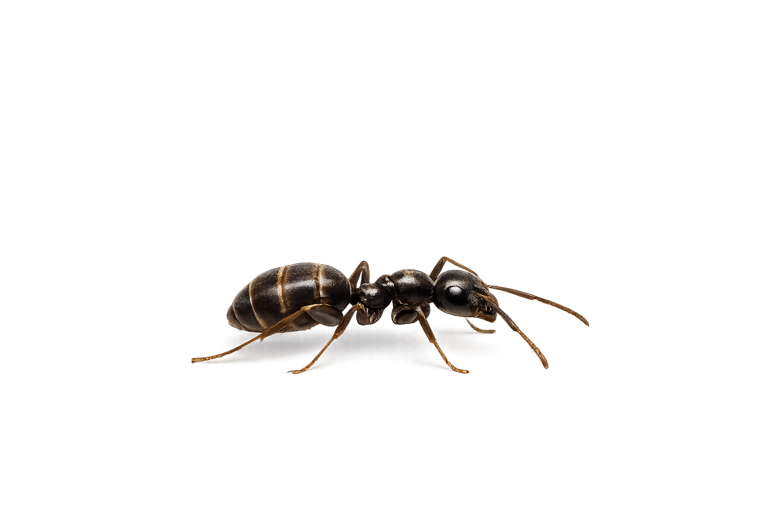
The most frequent invader in St. Louis homes. Small (1/8 inch), dark brown to black, they emit a rotten coconut smell when crushed. Colonies can have multiple queens and hundreds of thousands of workers, making them extremely persistent. They nest in wall voids, under slabs, and in mulch beds.
Carpenter Ants
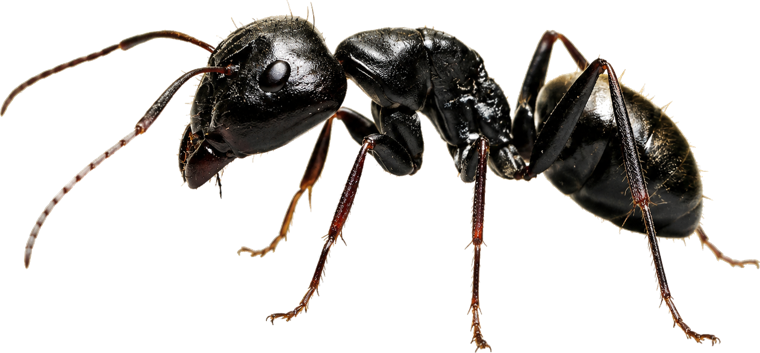
Missouri’s largest ant species (up to 1/2 inch). Black or dark red, they excavate galleries in water-damaged or softened wood. Unlike termites, they do not eat wood — they remove it to create nesting space. Sawdust piles (frass) near baseboards or window frames are a telltale sign.
Pavement Ants
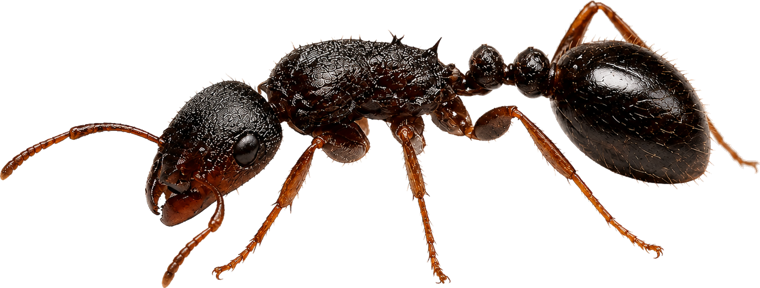
Small, dark brown ants that nest under sidewalks, driveways, and foundation slabs. You will often see small mounds of displaced soil along expansion joints and cracks. They forage indoors along plumbing lines and slab edges.
Pharaoh Ants
Tiny (1/16 inch), yellow to light brown ants that are notoriously difficult to control. Standard repellent sprays cause colony budding — the colony splits into multiple new colonies, making the problem worse. Pharaoh ants require specific bait protocols.
Signs of an Ant Problem
- Ant trails along baseboards, countertops, window sills, or door frames
- Fine sawdust (frass) near wood structures — indicates carpenter ants
- Soil mounds along sidewalks, driveways, or foundation cracks
- Ants emerging from wall outlets, light switches, or plumbing penetrations
- Persistent activity that returns within days of using store-bought sprays
- Winged swarmers appearing indoors, especially in spring
How Roberts Treats Ants
Roberts uses a targeted, multi-product approach to ant control. For active infestations, we apply a non-repellent perimeter treatment around the foundation. This non-repellent chemistry means ants walk through it unknowingly and carry it back to the colony, creating a transfer effect that eliminates the entire nest — not just the ants you can see.
Inside, we use professional-grade residual spray along baseboards and entry points, combined with gel bait placed near active trails and foraging areas. The gel bait is carried back to the colony and shared through trophallaxis (food sharing), killing the queen and collapsing the colony from within.
For carpenter ants, we add void treatment — injecting product directly into wall voids and galleries where the colony nests. For pharaoh ants, we use specific bait formulations designed to avoid colony budding.
Ant control is included in our R.O.S. (Regular Outside Service) program, which uses a 3-chemical rotation system to keep ants and other crawling pests out year-round. Learn more about R.O.S. →
Prevention Tips
- Eliminate moisture — Fix leaky pipes, poor drainage, and condensation. Carpenter ants are especially attracted to water-damaged wood.
- Seal entry points — Caulk cracks around your foundation, windows, doors, and where utility lines enter.
- Clean food sources — Store food in sealed containers, clean up crumbs promptly, and don’t leave pet food out overnight.
- Manage landscaping — Keep mulch 12+ inches from the foundation. Trim branches and shrubs away from the house.
- Move firewood — Store firewood at least 20 feet from the house, elevated off the ground.
- Address moisture in crawl spaces — Ensure proper ventilation and consider encapsulation for persistently damp areas.
Colony Elimination
Non-repellent transfer products spread through the colony — eliminating the source, not just the scouts
Species ID Matters
Different ants require different treatments — carpenter ants need void treatment, pharaoh ants need specific baits
Perimeter Defense
Our R.O.S. program maintains a chemical barrier that stops ant invasions before they start
No Contracts
One-time treatments or ongoing R.O.S. protection — your choice
Tired of ants in your kitchen? Roberts Pest Control eliminates colonies at the source — not just the scouts you see.
Call (314) 967-2847 (BUGS)Why Choose Roberts?
- Colony-Killing Chemistry — Non-repellent transfer products eliminate the entire colony, not just surface ants
- Species-Specific Treatment — We identify the species first, then select the right protocol
- R.O.S. Perimeter Defense — Ongoing protection with every bi-monthly service visit
- No Contracts Required — One-time treatment or ongoing R.O.S. — you decide
What to Expect
- Free Inspection — We identify the ant species, locate entry points, and assess the severity of the infestation.
- Species Identification — Different ants need different treatments. We determine exactly what you're dealing with.
- Targeted Treatment — Non-repellent perimeter spray, gel baits, and void treatments customized to your situation.
- Prevention Plan — We seal entry points, recommend changes, and set you up with R.O.S. if you want ongoing protection.
Service Area
- Jefferson County (Festus, Crystal City, Arnold, Imperial, Barnhart, High Ridge, Hillsboro, De Soto, Herculaneum)
- St. Louis County (South County, Mehlville, Oakville, Affton, Kirkwood, Webster Groves, Crestwood)
- St. Charles County (St. Charles, O'Fallon, St. Peters, Wentzville, Lake St. Louis)
- St. Francois County (Farmington, Park Hills, Bonne Terre, Desloge)
- Ste. Genevieve County
- Washington County (Potosi, Mineral Point)
- City of St. Louis and surrounding municipalities
- Franklin County (Union, Washington, Pacific, Sullivan)
Schedule Your Free Estimate
Fill out the form below and we’ll get back to you fast — usually same day.
Frequently Asked Questions
How do I know what kind of ants I have?
Our technicians identify the species during a free inspection. Common St. Louis species include carpenter ants (large, black, found near moisture-damaged wood), odorous house ants (small, dark, coconut smell when crushed), pavement ants (small mounds along cracks), and pharaoh ants (tiny, yellowish). Each requires a different treatment approach.
Can carpenter ants cause structural damage like termites?
Yes, carpenter ants can cause significant structural damage over time. The key difference is that carpenter ants excavate wood for nesting — they don’t eat it. They prefer wood that has been softened by moisture, so fixing water damage and leaks is critical to both prevention and treatment. If you see sawdust piles (frass) near wood structures, call us immediately.
How long does professional ant treatment take to work?
You’ll typically see a significant reduction within 48-72 hours. Complete colony elimination with non-repellent products and baits usually takes 1-2 weeks, since the product needs time to spread through the colony via the transfer effect. You may actually see increased activity for a few days as the product circulates — that’s a good sign.
Why do ants keep coming back after I spray them?
Store-bought sprays are repellents — they kill the ants you can see but drive the colony to relocate and re-enter from a different spot. Some species (like pharaoh ants) will actually split into multiple colonies when exposed to repellent products, making the problem much worse. Professional non-repellent products and gel baits eliminate the colony at the source.
Is professional ant treatment safe for kids and pets?
Yes. We use EPA-registered products applied according to label directions. Gel baits are placed in cracks and crevices out of reach. Our technicians will advise you on any specific precautions for your situation.