


Ant Control & Prevention
Ants in St. Louis
Ants are the #1 pest complaint in Missouri. Learn to identify carpenter ants, odorous house ants, and pavement ants.
Meet the Ants of the St. Louis Area
A handful of species cause almost all local ant calls. Here’s how to tell them apart — and why the right ID changes the treatment.
Carpenter Ant
Camponotus spp.
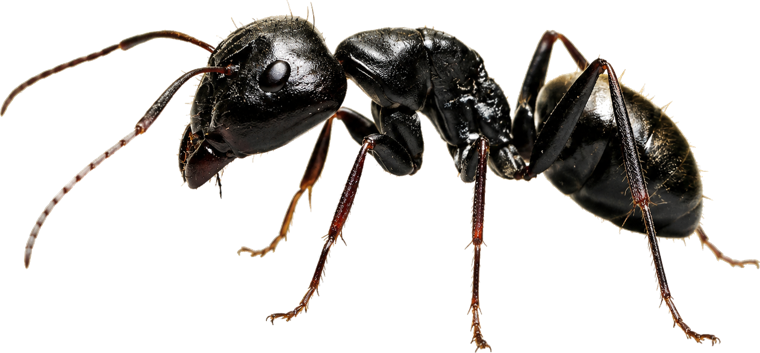
Identify: Among the largest ants you’ll see indoors — workers range ¼ to ½ in. and vary in size. Blackish (some black-and-red), with a single-node waist, an evenly rounded back, and jaws strong enough to pinch.
Life cycle: One queen per colony; a nest matures in about 3–6 years and 2,500+ workers (large ones top 100,000). Winged swarmers appear mainly in spring, sometimes indoors on warm late-winter days.
Habits & risk: They excavate smooth, almost sanded galleries in moist or water-damaged wood — they do not eat it, and push the shavings out. Finding those shavings is the tell. Usually a sign of a moisture problem; the main nest is often outdoors with satellite nests inside.
Odorous House Ant
Tapinoma sessile
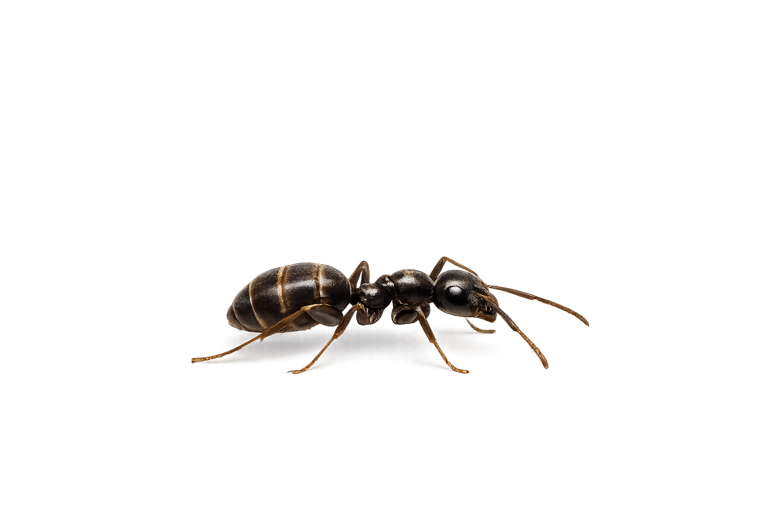
Identify: Small — &frac1;⁄₁₂ to ⅛ in., brown-black, with a single hidden, flattened waist node. Crush one and it smells like a rotten coconut — the fastest field ID.
Life cycle: Colonies are large and hold many queens, so they split readily into sub-colonies (budding) and are hard to knock out with sprays alone.
Habits & risk: Follows well-defined trails indoors to sweets; pushes inside in late fall and after heavy rain when its honeydew supply drops. Nests in wall voids and beneath floors. A persistent kitchen trailer.
Pavement Ant
Tetramorium caespitum
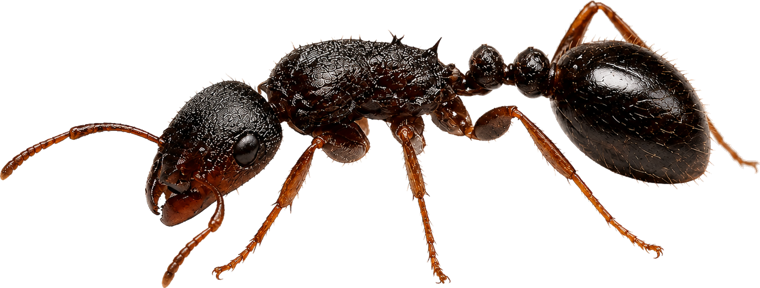
Identify: Small — ⅛ to ⅙ in., dark brown-black with paler legs, a pair of tiny rear spines, and fine parallel grooves on the head and thorax. Two-node waist.
Life cycle: Slow-moving; a common “tramp” ant of the Midwest. Colonies nest outdoors and forage into buildings for food.
Habits & risk: Nests under sidewalks, driveways, slabs and stones next to the foundation — the little soil piles at pavement cracks are its calling card. At slab homes, foragers come up through cracks after both greasy and sweet food.
Identification and biology per Truman’s Scientific Guide to Pest Management Operations, Ch. 10.
Need Professional Treatment?
Visit our full service page for detailed treatment information, pricing, and prevention tips.
Get Help with Ants
Free Quotes. Locally owned, licensed & insured.