


Late-Summer Yellowjackets in St. Louis: Why August and September Are the Sting Months
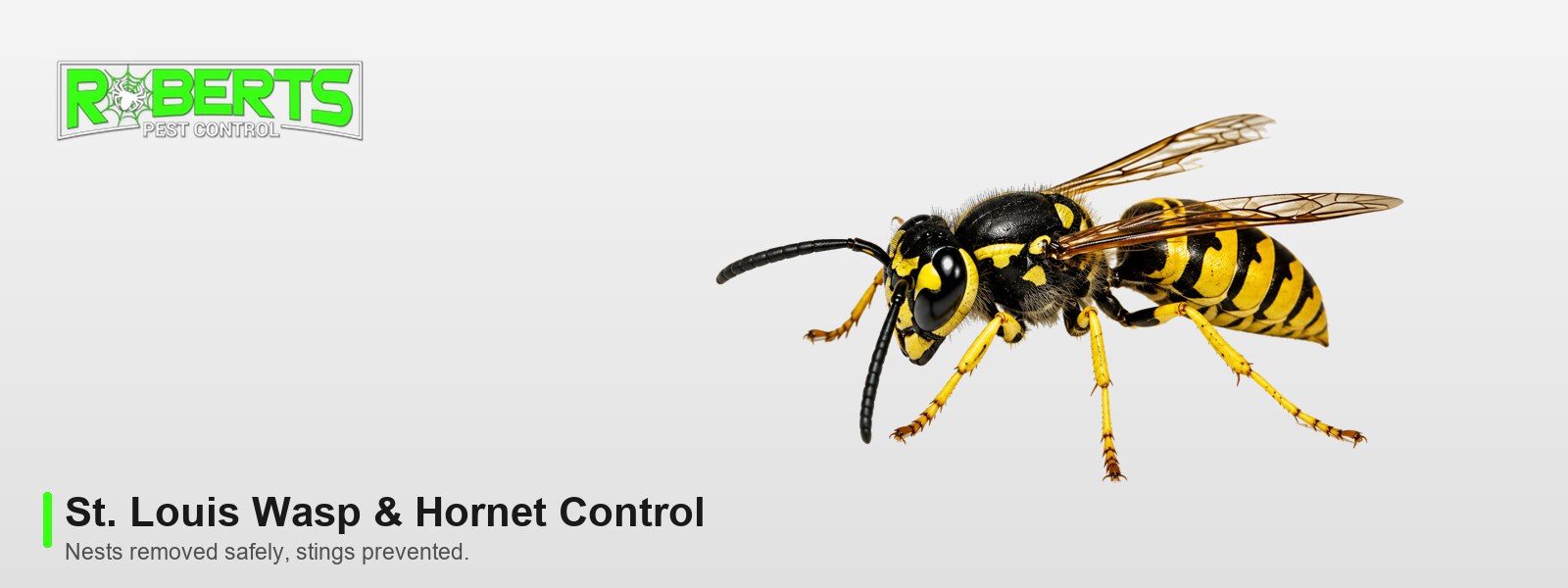
If it feels like the wasps around your deck got meaner sometime in the last two weeks, you are not imagining it. Late summer yellowjackets behave differently than the same insects did in June, and mid-August through late September is when we get the most sting calls across Jefferson County and the wider St. Louis metro. Nothing about the yellowjacket changed. What changed is where the colony is in its year.
The colony calendar: why August is peak yellowjacket
A yellowjacket colony is an annual project. One fertilized queen who overwintered somewhere protected starts a nest by herself in spring, and through May and June the colony is small and mostly invisible to you. Those workers then spend the whole summer building. By mid-August a ground nest that started as a golf-ball-sized comb can hold thousands of workers, and that population stays high until the first hard cold snap — which around St. Louis is usually well into October. So the first reason you are seeing more yellowjackets is the simplest one: there are far more of them in the yard than there were eight weeks ago.
The second reason is diet. All summer, workers hunt protein — caterpillars, flies, spiders — to feed the developing larvae back in the nest, and the larvae reward them with a sugary secretion. Late in the season the queen shifts to producing next year’s reproductives and larval numbers fall off. The workers lose both their job and their sugar source, and they go looking for carbohydrates on their own. That is why the same insect that ignored you in June is suddenly investigating your soda can, your trash lid, and the pulled pork.
Per Truman’s Scientific Guide (Ch. 10), the industry’s standard reference: the yellowjacket is the scavenging “picnic wasp” that goes after both meat and sweets, nests underground or in wall voids, and is at its worst in late summer and early fall. Truman also calls it the most dangerous social stinging insect in the United States — and notes that most stings come from disturbing a nest people did not know was there.
Know which stinger you actually have
Treatment and risk both depend on the species, and the four you are most likely to meet in a Missouri yard this month look nothing alike once you know what to look for. We keep photo comparisons of all of them on our wasp and stinging insect page.
- Yellowjacket — small, stocky, bright yellow-and-black, flies fast and direct. Nests underground or inside a wall void. This is the one at your picnic and the one that stings in groups.
- Paper wasp — longer and more slender, legs dangling in flight, builds the open umbrella-shaped comb you find under an eave, a porch ceiling, or a grill lid. Defensive rather than aggressive; it stings when you get close to the comb.
- Baldfaced hornet — black and white, and the builder of the big gray football-shaped paper nest in a tree or shrub. Very defensive about that nest.
- Carpenter bee — looks like a bumble bee but with a bare, shiny black abdomen. The males that hover in your face all spring cannot sting at all. The real problem with carpenter bees is the half-inch round holes they bore into eaves, decks and fascia year after year.
One more: a heavy cluster of fuzzy amber-and-black bees, or a comb full of wax and honey inside a wall, is a honey bee colony, not a yellowjacket. Honey bees are pollinators, and a local beekeeper is often the right call rather than an exterminator.
Where the nests hide in a St. Louis yard
Yellowjackets almost never build somewhere obvious. Around here we pull them out of the same spots over and over:
- Abandoned rodent burrows. A ground nest usually starts in a cavity somebody else dug. Old mouse, vole and chipmunk burrows along a foundation or a fence line are prime real estate, which is one of several reasons that rodent activity around the outside of a house is worth dealing with before fall.
- Landscape beds and retaining walls. Loose mulch, the void behind a timber wall, and the gap under a landscape block all work.
- Wall voids and soffits. A gap at a fascia joint, a rotted trim board, or an unscreened gable vent gets them into the wall, where the nest is completely out of sight until traffic in and out gets heavy.
- Under decks and steps, inside a hollow porch column, or right in the middle of the lawn — where the entrance can be a hole no bigger than a quarter.
The single most common way people find a ground nest in August is by running a mower or a string trimmer over it. Before you cut, stand still for a minute and watch the areas you are about to hit. Steady two-way traffic into one small hole is the tell. That one minute prevents a lot of emergency room visits.
What not to do
Most of the bad outcomes we get called about start with one of these.
- Do not plug the entrance hole on a wall-void nest. This is the big one. Sealing the outside entrance does not trap them — it makes them chew and push in the other direction, which is toward the inside of your house. Foam and caulk go on after the colony is dealt with, never before.
- Do not pour gasoline, bleach or kerosene down a ground nest. It is a fire hazard, it contaminates your soil and groundwater, and it is not a legal pesticide use. It also frequently does not kill the colony.
- Do not treat a nest from a ladder. A stinging insect response plus a ladder is how people break bones. If the nest is above head height, that is a job for somebody with the right equipment.
- Do not knock down a paper wasp comb in daylight, and do not swat. Crushed yellowjackets release an alarm pheromone that recruits nestmates. Walk away calmly instead.
What you can do this week
These are genuinely effective, and all of them are homeowner work:
- Lock down the food. Tight-fitting trash and recycling lids, rinse the cans and bottles, and keep the bins away from the patio door. Scavenging foragers follow odor.
- Cover your drinks outside. Use cups with lids or straws instead of open cans. A yellowjacket that crawls into a can and gets swallowed causes a throat sting, which is a true emergency.
- Pick up fallen fruit under crabapples, pears and grapes, rinse the grill after cooking, and bring pet food bowls in at night.
- Walk the exterior once and note every spot you see wasps entering something — a soffit seam, a gap under the siding, a hole in the lawn. Mark it and stay 10 feet back.
- Fix the openings in late fall or winter, not now. Once the colony is gone, screen the gable vents, replace rotten trim and seal the fascia gaps so next year’s queen picks somebody else’s house.
When a sting is an emergency
Unlike honey bees, yellowjackets do not lose the stinger and can sting repeatedly, and disturbing a ground nest often means multiple stings in seconds. A normal reaction is pain, redness and local swelling for a day or two, and ice plus an antihistamine is usually enough.
Call 911 for any sting that brings on trouble breathing, throat or tongue swelling, hives spreading away from the sting site, dizziness or fainting. Also seek care for a sting inside the mouth or throat, and for a large number of stings at once. If anyone in the household carries an epinephrine auto-injector, know where it is before you start yard work in August.
How we handle it — and why we go after the nest
Spraying the wasps you can see accomplishes very little. Those are foragers, and the colony replaces them out of the brood comb within days. The nest itself is the target, and getting to it in a wall void or three feet down a burrow is the part that takes equipment and experience.
Roberts Pest Control is locally owned, based in Festus, and licensed and insured. Our techs handle yellowjacket, paper wasp and baldfaced hornet nests, and we work them at the source. Expect a knockdown at the nest first and then a follow-up look, because a large ground colony can hold a lot of workers who were out foraging when we treated. If you are still seeing activity between visits, call or text and we will come back out.
Two things worth knowing while somebody is already on your property in the late-summer window. First, the exterior service that suppresses wasp harborage is the same visit that knocks back the spiders, crickets and occasional invaders that start pushing toward the house as nights cool in September — see our fall pest prevention checklist for that list. Second, walking a foundation for ground nests is exactly where mud tubes turn up — the pencil-width soil tunnels subterranean termites build up a foundation wall. If we see them, we will tell you, and we will show you the difference between a colony we can eliminate with the Sentricon® system and damage that is already done. We are a Certified Sentricon Specialist®, so that conversation is a real one and not a handoff.
Wasps on the house? Let us take a look.
Free estimates on pest and termite work across Jefferson, St. Louis, St. Charles, St. Francois, Washington and Ste. Genevieve counties. Locally owned, licensed and insured, based in Festus.
More reading: Wasps & stinging insects · General pest control · Rodent control